

FANUC Robots
7 articlesFANUC robot, teach pendant, drive and board repair
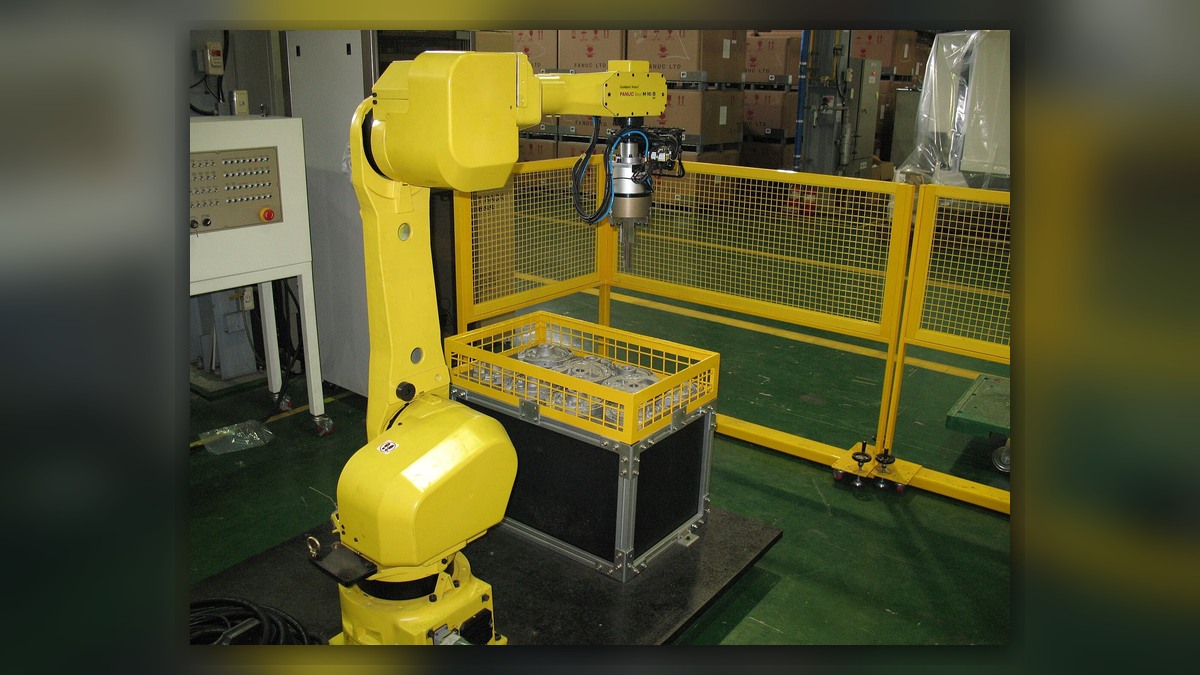
What Evidence Is Required for a FANUC Robot Repair Review of Intermittent Position or Path Deviation?
A useful repair review requires repeatable production evidence that separates the observed deviation from assumptions about its underlying cause.
Read article →Repair of a Broken FANUC Robot Body Cable A660-4005-T215
The FANUC robot body cable A660-4005-T215 is an integrated, dedicated cable harness that combines power transmission with servo signal feedback, conforms to arm cable routing standards for multiple six-axis general-purpose models, and performs core functions including axis power delivery, position signal feedback, and servo parameter exchange.
Read article →FANUC Robot Does Not Move After Power-Up: Repair
When the robot does not move after power-up, first check the emergency stop, safety doors, servo enable status, and control cabinet alarm information to avoid replacing components directly.
Read article →Standard Maintenance for the FANUC M-2000iA Robot
As a heavy-duty, large-payload industrial robot designed for extreme load conditions, the FANUC M-2000iA features reinforced body structures, load-bearing joints, and torque output units, and is widely used in high-intensity production scenarios such as handling heavy castings, transferring complete vehicle bodies, installing and removing large molds, and positioning heavy industrial equipment.
Read article →FANUC M-410iC/315 Robot Maintenance
The FANUC M-410iC/315 is a widely used industrial robot for heavy-payload palletizing and material handling. Its structure is reinforced for heavy-duty operation, providing high load capacity and a wide working envelope. Typical continuous-duty applications include warehouse transfers, building-material palletizing, box stacking, and arranging heavy workpieces.
Read article →Three Key Advantages of the FANUC P-250iB Painting Robot
The FANUC P-250iB is one of the most flexible and advanced painting robots currently on the market. It offers multiple mounting options to meet the demands of challenging painting environments. Its OpenArchitecture design allows it to accommodate standard FANUC integrated process equipment and makes it easy to integrate third-party industrial equipment.
Read article →Classification of FANUC Robots and Three Key Advantages of the FANUC-P-250iB Painting Robot
FANUC robots are classified into four types according to their arm motion. Cartesian robots move along three Cartesian axes; cylindrical robots provide vertical, rotary and extension movements; spherical robots provide rotary, pivoting and extension movements; and articulated robots have multiple rotary joints. FANUC robots can also be classified by their motion control capabilities.
Read article →