

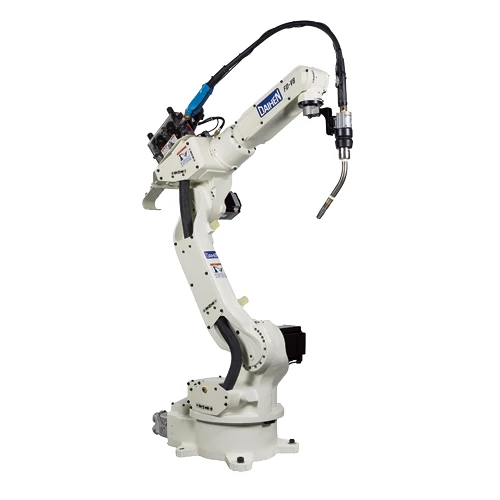
An OTC FD-V8 weld interruption should be recorded by sequence, not only by the final weld appearance. The robot may stop because the power source returned a fault, the feeder lost readiness or the program waited for a completion state. A damaged robot axis is one possibility among several. Preserve the first event and the weld step.
Confirm the complete FD-V8 robot, controller, welding power source, feeder and torch. The robot product reference does not establish the installed welding protocol, consumable or parameter values. Use the actual integration drawings and welding procedure for those details.
Record the first interrupted weld step
Save the job, weld segment, joint, robot position and first message. Mark whether the interruption occurs before arc start, during travel, at a wire event or during the completion handshake. Keep the workpiece, fixture and consumable identity. A later “program stopped” message is not the same as the source event.
- Robot request, source ready, arc and fault-return states.
- Wire feeder response and torch service history.
- Gas and work-return conditions under the welding procedure.
- Recent downloads, connector work or schedule changes.
Separate source readiness from robot motion
If the robot reaches the weld point but the source is not ready, review the source and interface branch. If the source indicates a weld fault while the robot continues, inspect the return mapping and the program response. If the robot path itself stops before a weld request, use the robot-side branch. Keep the three states on one timeline.
A fieldbus or network connection does not prove that the current readiness or fault bit is mapped correctly. Compare device identity, direction, timing and logic inversion with the installed design. State the recording resolution because short ready or fault pulses may be missed by a screen.
Build a trace with separate columns for the robot request, source readiness, arc-established state, source fault and completion acknowledgement. Use the exact signal names from the integration record. Record which device produces each state and which task consumes it. A completion acknowledgement can describe the end of a command sequence; its name alone does not demonstrate a sound weld or a successful quality inspection.
Inspect wire feed and torch conditions
Under the fitted welding procedure, inspect the spool path, liner, feed rollers, contact tip, torch neck and cable route. A worn tip or restricted liner can interrupt a weld without a robot fault. Match consumables and adjustments to the installed wire and power source. Do not infer current, voltage or feed settings from the FD-V8 model.
| Pattern | Next comparison | Unproven conclusion |
|---|---|---|
| No weld request | Program permissive and schedule | Torch failure |
| Source not ready | Power source and interface | Robot drive fault |
| Wire feed changes first | Feeder and torch circuit | Every point needs reteaching |
| Fault return not received | Mapping and timing | Weld quality is acceptable |
Compare the work-return path and shielding conditions
The welding work-return connection and protective earth have different functions. Use the welding equipment instructions to inspect the designated return connection, contact surface and cable route. An unintended current path through fixtures or bearings is not a substitute for the intended welding circuit. Keep electrical findings separate from the robot motion record, and obtain the appropriate equipment assessment where the circuit condition is uncertain.
For shielding gas, record the approved gas identity and the check location. A supply-side reading does not establish the condition at the torch during welding. Leaks, restrictions or a changed torch assembly need the process-specific check. Do not compensate for a suspected gas or wire problem by changing several weld parameters together; that makes the next comparison harder and may change weld qualification.
Control restart after an interrupted bead
Preserve the last completed segment and the part disposition before a restart. Determine from the approved procedure whether the interrupted joint can be repaired, must be inspected first or should be held. Resetting a robot wait does not decide that question. Confirm that source and robot agree on the current job and that stale ready or completion states will not advance the sequence unexpectedly.
Where the installation uses schedule numbers or recipes, save the requested identifier and the source-selected identifier. A matching network connection can still carry the wrong schedule. Compare the last approved versions before any correction. Record the resulting change as an integration or process correction, with weld inspection still required; it should not be described as a repaired robot drive.
Keep weld inspection separate from sequence repair
A repaired sequence can establish an arc and still produce a weld that needs procedure or quality review. Use the approved inspection method for bead shape, penetration, porosity or other requirements. Conversely, a visually acceptable bead does not prove that every fault-return and protection condition was validated. Record each conclusion separately.
Repair the confirmed boundary and verify the complete cycle
A consumable or feeder finding needs its matching service action. A cable or connector defect needs routing and electrical verification. A mapping problem needs a backed-up integration correction. A power-source fault belongs to its service route. Record the installed part, procedure version and the test that supports the repair.
Verify a representative joint with the same material, tool, program segment and relevant restart condition. Confirm request, readiness, arc, interruption handling and completion. Record repeat count and weld inspection results. A dry robot path or component bench test is not installed-cell acceptance.
Welding robot inspection and repair
Contact Suntech with the FD-V8 welding record
Equipment reference
Existing FD-V8 equipment reference used in the site inventory
OTC FD-V8 maintenance planning
Review the full welding robot cell before isolating one process signal.