

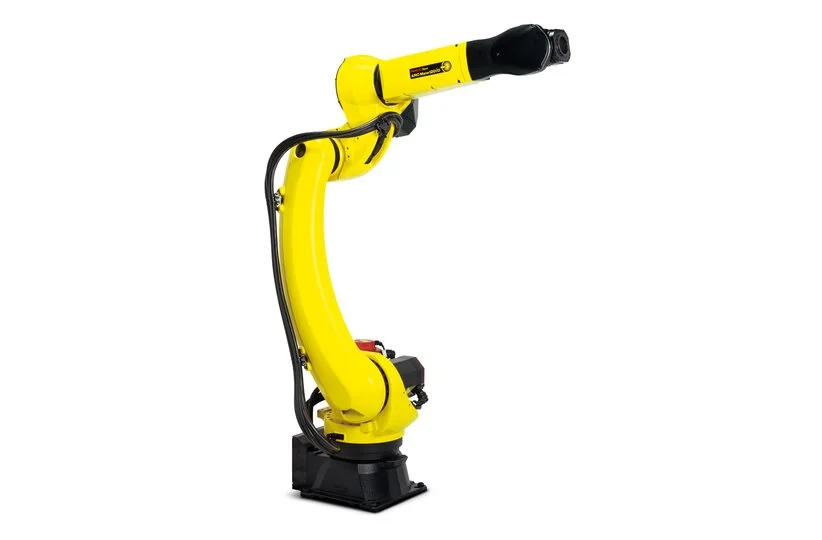
A FANUC ARC Mate 120iD that changes its weld position after hosepack or torch work should be checked from the physical tool outward. A new hosepack can alter torch orientation, strain relief and the effective tool center point. A fixture shift or a job selecting an old tool definition can look similar. Do not reteach every weld point before preserving the first changed joint.
FANUC lists ARC Mate 120iD as a six-axis arc-welding robot with a specific product identity. The product page does not define the installed torch, feeder, weld procedure or customer acceptance tolerance. Use the actual integration drawing, controller documents and welding procedure for those details; do not transfer a setting from ARC Mate 100iD or another ARC Mate variant.
Preserve the first changed weld joint
Record the job, joint, robot pose, approach direction, torch orientation, wire identity and first message. Mark whether the torch was replaced, the hosepack was rerouted, a connector was opened or a fixture was touched. Keep the last accepted bead and the first changed bead as separate evidence. A later arc fault may be a consequence of a shifted torch.
- Hosepack, torch neck, contact tip and adapter identity.
- Tool frame number and its last approved revision.
- Fixture datum, workpiece presentation and path revision.
- Wire-feed and weld-procedure versions used for comparison.
Inspect torch mounting before changing TCP data
With the cell in the required safe state, compare the torch mount, locating features, adapter orientation, contact-tip projection and fasteners with the approved assembly. A clamp that is seated on a different face can create a repeatable shift, while a loose mount can create a spread. Record the physical condition before tightening or replacing anything.
Compare a known fixture feature with the torch using the applicable measurement method. Keep orientation, units and sign direction in the record. A visual gap at one angle cannot distinguish a TCP shift from a fixture move. Check more than one feature before deciding which reference layer changed.
Separate hosepack routing from tool-frame identity
Inspect the hosepack at the affected wrist pose and approach direction. A tight loop, displaced restraint or connector carrying load can rotate the torch only during one movement. A static continuity test does not close a dynamic routing finding. Keep the route photographs and tool-frame record together, but assign each finding to its own repair action.
Confirm that the active job selects the repaired tool number and the current tool frame. A corrected definition stored in a backup is irrelevant if the production job calls another number. Review shared jobs before changing a frame, because a correction for one fixture can shift another task that uses the same data.
| Pattern | Compare next | Not established |
|---|---|---|
| Repeatable shift after hosepack work | Mounting and tool frame | Robot calibration fault |
| Spread changes with wrist pose | Route and restraint | TCP data alone is wrong |
| One fixture feature moves | Fixture datum and part | Torch is damaged |
| Path is correct; bead changes | Feed, material and procedure | Robot position fault |
Keep weld quality separate from position evidence
A corrected TCP can place the torch correctly while the feeder, wire, gas or process remains unsuitable. Conversely, a good-looking bead does not prove that the torch path and hosepack clearance are correct across the whole job. Record the robot position check, consumable check and weld inspection as separate conclusions.
Use the same material, procedure, part presentation and inspection method before and after the repair. Record whether the observation is bead appearance, penetration, dimensional position or another approved criterion. Do not infer current, voltage or feed values from the robot model page.
If the hosepack replacement changed a connector, strain-relief point or torch balance, include that change in the comparison. A cable assembly can be electrically sound and still impose a different mechanical load on the wrist. Record the route at the original approach and at the return move; both directions can bend the package differently.
Do not use an average correction to hide a repeatability spread. If the torch is stable at one joint but changes at another, retain the pose-specific evidence and check the route or mount before applying a global tool-frame change. The final report should identify the first condition that was changed and the result under the same test.
When the tool frame is updated, preserve the old value, new value, reason, approver and affected job list. A frame change is not a substitute for a damaged torch repair. The production handover should state whether the weld location, hosepack route and weld inspection each passed, remained open or were outside the test scope.
Keep the accepted bead and measurement record with the final tool version.
Repair the confirmed boundary and verify representative joints
A mount or hosepack defect needs the matched assembly correction and dynamic route check. A tool-frame issue needs a controlled reference update with a backup. A fixture issue belongs to the cell record. Only independent robot evidence should lead to an arm or drive diagnosis. Keep the original and revised versions for rollback.
Verify the original approach, torch orientation, cable route, arc start, representative weld and agreed inspection. Include more than one orientation and the relevant restart behavior. Record repeat count and any remaining restriction. A dry path or one successful bead cannot close a hosepack-induced TCP shift.
Welding robot inspection and repair
Contact Suntech with the ARC Mate record