
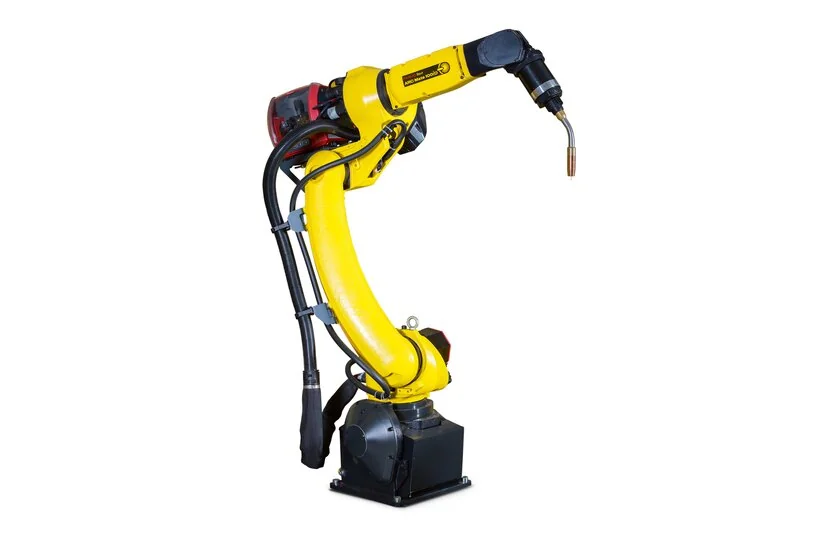
A FANUC ARC Mate 100iD can arrive at the weld start position while the arc fails to establish. That symptom does not identify a robot axis fault. The failure may occur between the weld request, power-source readiness, wire delivery and the return confirmation. Follow that sequence before replacing a controller or retouching the path.
Identify the complete robot model, controller, welding package, power source, feeder and torch. FANUC describes the ARC Mate 100iD as an arc-welding robot with integrated service routing features. That product description does not establish the installed welder protocol or consumable specification. Keep the integration drawings and each fitted device manual with the fault record.
Separate no request from failed arc establishment
Record the first message, job and start step. Determine whether the robot requested welding and whether the power source accepted the request. A missing request leads toward program conditions or interface logic. An accepted request with no established arc needs the welding-system branch. A returned arc signal that is not received by the robot needs a return-path check.
- Request, readiness, arc-established and fault states on a common time reference.
- Part, joint, fixture, weld schedule and consumable identities.
- Wire behavior at the start and any burnback or feed irregularity.
- Torch service, liner changes, cable work and recent downloads.
Inspect wire delivery as a separate mechanical path
With the welding equipment isolated to its service procedure, inspect the spool path, feeder, liner and contact tip. A worn tip, incorrect liner, damaged conduit or unsuitable feed setup can disturb wire delivery. Match consumables to the installed wire and process. The correct feeder adjustment comes from its manual and the approved welding procedure, not a universal robot setting.
A wire-feed test and an arc test answer different questions. Stable delivery without an arc does not verify the welding current path or arc confirmation. Conversely, an arc event does not prove that delivery remains stable through all torch orientations. Record the test conditions and do not interpret a single successful start as proof of a complete repair.
Check torch condition and routed services
Inspect the nozzle, tip attachment, insulators and the identified service route as required by the fitted torch documents. Look for impact evidence, spatter or a routing change that followed maintenance. Integrated routing does not remove the need to match the installed cable pack and permitted bend conditions. Keep torch geometry separate from the programmed tool reference.
| Observation | Check next | Do not infer |
|---|---|---|
| No weld request | Program and permissive logic | Torch hardware has failed |
| Welder not ready | Source status and documented interface | Robot drive replacement is needed |
| Wire delivery is irregular | Feeder, liner, tip and route | Every weld point needs editing |
| Arc occurs; robot reports no confirmation | Return signal and timing | The weld quality is acceptable |
Review gas and current-path conditions
For a process that requires shielding gas, verify the identified gas supply and actual delivery using the approved method. A normal regulator display does not prove flow at the torch during welding. Review the work return connection, fixture contact and specified welding circuit. These are welding-system checks; they should not be confused with the robot protective-earth circuit.
An unstable or contaminated weld also needs the material and welding-procedure review. Robot maintenance cannot by itself approve welding quality. Do not invent current, voltage, gas-flow or wire-speed values from the model name. Use the applicable welding procedure and fitted power-source documentation for limits and acceptance.
Choose consumable, interface or component repair
A confirmed consumable defect calls for the matched replacement and setup check. An identified cable or connector fault needs its specific repair. A mapping or readiness problem needs controlled integration work with a backup. Escalate an internal power-source fault through the appropriate service route. A robot controller change should have independent supporting evidence.
Verify the sequence and the resulting weld
Begin with the prescribed assembly and electrical checks, followed by an approved dry sequence where appropriate. Use guarded welding conditions, ventilation and the specified protection for the actual arc test. Verify request, readiness, arc establishment, completion and recovery. A dry robot movement cannot demonstrate arc reliability, gas coverage or weld quality.
Acceptance should use representative joints and the approved welding procedure, with the agreed inspection method and repeat count. Save the repair details, consumables, program version and weld inspection results. Separate a bench component result from installed-cell acceptance. A normal-looking bead alone is not evidence that every specified weld requirement has been met.
Keep torch position and arc response separate
Compare the approved tool geometry, wire extension and start position after torch service. A changed neck or contact-tip arrangement can alter the physical relationship even when the robot program is unchanged. Verify that geometry using the installed tooling procedure before compensating with new path points. Keep any program change separate from consumable replacement in the service record.
If the robot and welder logs use different clocks, align them using an identifiable event and record the remaining uncertainty. A display refresh may hide a short ready or confirmation transition. Do not claim that a timing limit was exceeded without a recording method that can resolve it.
A changed bead shape, porosity or lack of fusion requires the specified weld inspection and procedure review. These outcomes are not interchangeable with an arc-start confirmation. Preserve the distinction when reporting repair results so that electrical sequence success is not mistaken for weld acceptance.
Welding robot inspection and repair
FANUC robot repair and controller assessment
Contact Suntech with the robot and welding-system labels
Manufacturer reference
FANUC ARC Mate 100iD product information
Torch mounting and TCP checks after hosepack work
For the complete cell, compare the robotic welding process and fault guide.