

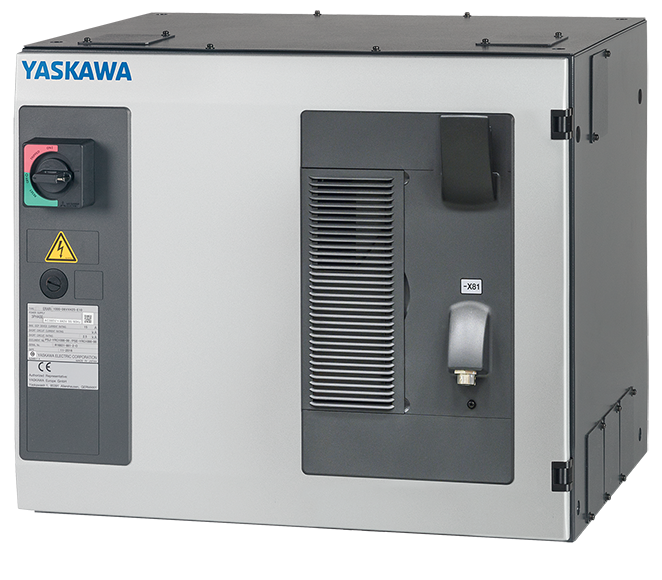
YASKAWA robot repair after an encoder battery alarm starts by distinguishing low battery from lost position data. On the YRC1000, alarm 4312 is ENCODER BATTERY ERROR. Alarm 4311 is ENCODER BACK-UP ERROR and concerns encoder initialization or position-data loss. Replacing a battery and restoring an accurate position reference are separate tasks. Record the full message and axis before any reset or disconnection.
This guide covers those YRC1000 entries, not every Yaskawa controller or robot model. The motor, encoder, backup circuit and software version determine the detailed maintenance procedure. YASKAWA robots with another controller need their own documents. A generic battery-change video is not evidence that its power state, connector order or recovery steps apply to the installed cell.
1. Separate alarm 4312 from alarm 4311
The official YRC1000 Alarm Codes manual identifies 4312 as an encoder backup-battery low-voltage condition. Its listed branches include the battery and connections. Record whether this is the first warning or one of several alarms after a shutdown. Do not diagnose a failed motor from the battery message alone.
For 4311, the manual describes incomplete encoder initialization and position data lost after backup-battery voltage drops. A fresh battery does not reconstruct a lost position reference. Keep any accompanying codes, affected axes and displayed home-position status. Do not enter convenient pulse values, copy another robot’s calibration or clear the history to make the screen look normal.
| Evidence | Meaning to investigate | Next step |
|---|---|---|
| 4312 with no reported position loss | Backup-battery condition and circuit | Check correct battery and preservation procedure |
| 4311 or undefined home-position data | Possible lost absolute-position reference | Assess restoration and calibration needs |
| Alarm returns after a battery change | Connection, specification or circuit fault | Inspect installation and backup path |
| More than one axis affected | Circuit layout and event sequence | Use the exact topology, not multiple motor guesses |
2. Preserve the machine state and a readable backup
Save the robot/controller labels, full alarm and subcode, affected group, shutdown history and recent motor or cable work. Record whether the robot moved while power was unavailable. Capture the actual axis-position and home-position displays. Keep the tool, user-frame and approved job data with the maintenance record.
Use the controller’s approved backup procedure, including CMOS.BIN where applicable. Verify that the files belong to this robot and can be read; the existence of an old filename is not a recovery plan. A controller backup is valuable, but it does not prove that the encoder still retains its current absolute data. Treat backup availability and position validity as separate findings.
3. Identify the correct battery pack and circuit
Locate the backup supply through the installed robot maintenance manual and wiring diagram. Distinguish an encoder backup battery from other controller batteries. Confirm the complete part number, chemistry, voltage specification, polarity and connector arrangement. A matching plug or nominal rating is not enough to approve an alternative pack.
Inspect accessible wiring, holders and connectors for loose locks, damage, corrosion and poor contact under the prescribed isolation conditions. Record the installation date if known and the actual pack identity. A voltage reading must follow the documented circuit and measurement method. Do not short terminals, recharge a primary cell or disconnect several packs merely to identify which alarm changes.
4. Plan replacement without losing retained data
The required power state and any temporary backup connection depend on the exact machine. Some retention procedures differ from ordinary isolated component work. A qualified maintainer must establish the prescribed method before opening the battery circuit. Secure the cell and follow its electrical-safety and axis-restraint requirements; this article does not prescribe a universal live replacement sequence.
Prepare the correct pack and verify polarity, cable routing and connection order from the model-specific instructions. Do not improvise a temporary power source or leave the backup circuit open while searching for a replacement. If the current position-data status is uncertain, stop the recovery sequence and obtain the correct maintenance guidance before attempting automatic motion.
5. If the alarm returns, test the backup path
A recurring encoder battery alarm can involve more than the battery itself. Compare the installed pack and connection with the required specification, then inspect the documented path between the pack and encoders. Look for damaged conductors, poor contacts and the maintenance change that preceded the warning. Record each verified section before considering a motor or controller-side component.
The YRC1000 manual also lists encoder and controller-side hardware among branches for 4311. Those entries do not justify replacing every listed part. Any substitution must match the actual configuration and preserve required backups. If the symptom is an encoder communication alarm rather than battery/data loss, follow that diagnostic branch instead of repeatedly replacing batteries.
6. Restore position only through the correct recovery method
If absolute data has been lost, establish which axes need position recovery and whether a valid reference record exists. Use the installed robot’s mastering or home-position procedure with the required physical references and test conditions. A recorded controller value alone is not proof that the mechanical axis is in the corresponding position.
After recovery, verify the position reference and the affected tool path before an automatic job. Check any tool or frame relationships that the work may affect. Do not drive directly to a saved production point on the assumption that replacing the battery restored calibration. Record who performed the recovery, which axes were affected and what evidence established the reference.
7. Separate battery acceptance from production release
Before the prescribed power-state checks, verify pack retention, polarity, connector locking and restored covers. Record battery/circuit checks completed under the maintenance procedure and review the alarm history. Complete any required power-cycle verification only after position-data preservation and recovery have been addressed. An absent warning does not certify geometric accuracy.
For cell release, verify the affected axes and clearance in the approved safeguarded sequence. Then check the agreed job, workpiece and load. Record position checks and any recurring alarms, and distinguish completed tests from untested production conditions. Do not report a repair as finished solely because alarm 4312 can be reset once.
Request YASKAWA robot repair assessment
Provide the robot and controller labels, exact 4312 or 4311 message, affected axes, pack identity, power-loss history and backup status. Include photos that identify connectors without exposing anyone to energized equipment. State what was disconnected or replaced. The information helps define whether the work concerns the battery circuit, feedback hardware or position recovery.
YASKAWA robots: repair and diagnostic guides
Encoder communication and feedback alarm repair
YASKAWA robots not moving: enable and I/O
Official YRC1000 source
Reference: Yaskawa YRC1000 Alarm Codes, 178644-1CD, RE-CER-A600, minor-alarm pages 271–272, entries 4311 and 4312. These entries support the distinction between battery condition and lost backup data. Battery replacement details and position recovery still require the installed robot maintenance procedure.